6 of 40
factors held up in every test. They were linked to citations on their own, kept their effect when all 40 were tested together, and pointed the same way inside the Houston census.
Both engines Let’s talk
Research / Houston AI Citation Study / Factors
Which website factors make a local business more likely to be cited by AI search? We tested 40 commonly recommended factors on 880 Houston-area business websites: 492 that Google AI Mode or Perplexity cited and 388 in the same industries that they did not. Six held up in every test: a meta description, reviews or testimonials on the homepage, a specific business type in the schema, prices, years in business, and city pages. Most of the other factors went with citations only because sites that do one thing well tend to do many. Link authority was mixed, and page speed, domain age and firewall settings showed no clear link.
This is part of the Houston AI Citation Study, which traced 3,102 citations in Google AI Mode and Perplexity answers to 232 local questions. Here we ask what the cited websites had in common.
01 / Key findings
880 Houston-area business homepages in 12 industries, crawled on October 30, 2026, the day the questions were asked. Odds ratios are adjusted for industry and link authority.
factors held up in every test. They were linked to citations on their own, kept their effect when all 40 were tested together, and pointed the same way inside the Houston census.
Both enginesfactors were more common on cited sites, but 27 of them were explained by others. Business schema, FAQ schema, llms.txt and fresh sitemaps all went with citations, but none added anything once the other factors were known.
Both enginesof Houston census sites were cited: those with reviews or testimonials on the homepage, against those without. The pattern held in all 11 industries where we could compare.
Census sitescensus sites without a meta description were cited. 96% of cited sites had one, against 79% of sites that were not cited.
Census sitesthe readable text. The median cited homepage had 1,028 words readable without JavaScript, against 510 for sites that were not cited. Perplexity cared about this more than AI Mode.
Perplexityof the website factors stood out for Google AI Mode. It cited only 51 of these sites, and its picks come from Google Business Profiles, so site factors explain Perplexity's citations far better than AI Mode's.
Google AI Mode02 / The scorecard
Share of cited and not-cited sites with each factor, or the median for counts. An odds ratio above 1 means sites with the factor were more likely to be cited.
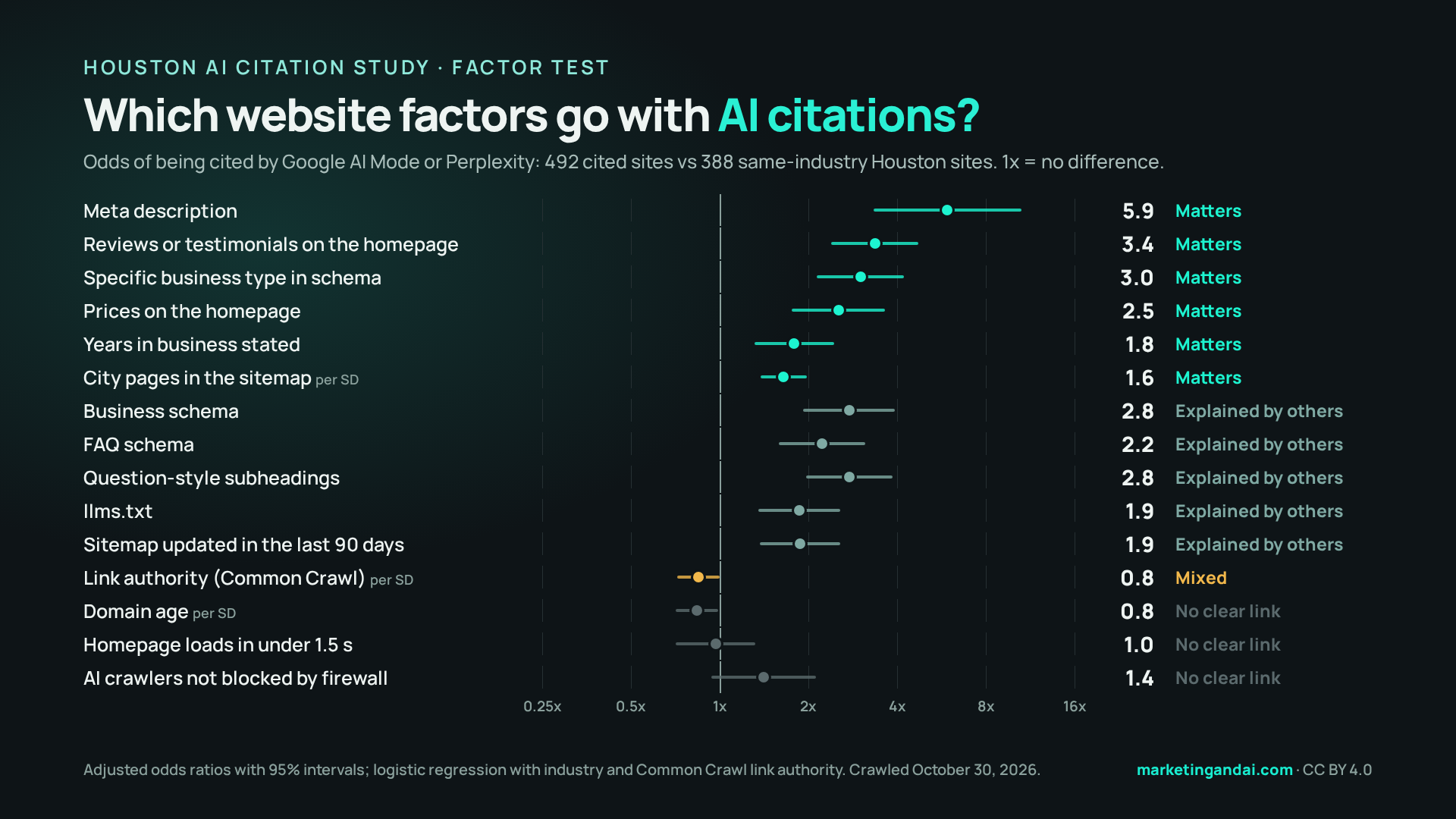
| Factor | Cited | Not cited | Odds ratio (95% interval) | Verdict |
|---|---|---|---|---|
| Meta description | 96% | 79% | 5.9 (3.3 to 10.5) | Matters |
| Reviews or testimonials on the homepage | 75% | 46% | 3.4 (2.4 to 4.7) | Matters |
| Specific business type in schema (Dentist, Plumber...) | 55% | 33% | 3.0 (2.1 to 4.2) | Matters |
| Prices on the homepage | 35% | 18% | 2.5 (1.8 to 3.6) | Matters |
| Years in business stated | 53% | 36% | 1.8 (1.3 to 2.4) | Matters |
| City pages in the sitemap | 69% (median 10) | 46% (median 0) | 1.6 per SD (1.4 to 2.0) | Matters |
| Tap-to-call phone link | 91% | 66% | 4.2 (2.7 to 6.5) | Explained by others |
| AI search crawlers allowed in robots.txt | 98% | 92% | 3.6 (1.6 to 7.9) | Explained by others |
| Link to its Google Business Profile or Maps | 70% | 47% | 2.9 (2.1 to 4.1) | Explained by others |
| Question-style subheadings | 69% | 43% | 2.8 (2.0 to 3.9) | Explained by others |
| Business schema | 83% | 61% | 2.8 (1.9 to 3.9) | Explained by others |
| Address and phone in schema | 69% | 45% | 2.6 (1.9 to 3.6) | Explained by others |
| Opening hours in schema | 58% | 36% | 2.3 (1.7 to 3.2) | Explained by others |
| Words readable without JavaScript | median 1,028 | median 510 | 2.2 per SD (1.8 to 2.8) | Explained by others |
| FAQ or Q&A schema | 46% | 25% | 2.2 (1.6 to 3.1) | Explained by others |
| Exactly one H1 | 77% | 60% | 2.2 (1.6 to 3.1) | Explained by others |
| Rating or review schema | 22% | 10% | 2.1 (1.3 to 3.3) | Explained by others |
| Service or offer schema | 24% | 12% | 2.1 (1.4 to 3.2) | Explained by others |
| sameAs profile links in schema | 62% | 43% | 2.0 (1.5 to 2.8) | Explained by others |
| Houston-area place names on the homepage | median 11 | median 4 | 1.9 per SD (1.6 to 2.3) | Explained by others |
| Sitemap updated in the last 90 days | 68% | 47% | 1.9 (1.4 to 2.6) | Explained by others |
| Links to directory profiles (Yelp, BBB...) | 29% | 18% | 1.9 (1.3 to 2.7) | Explained by others |
| llms.txt published | 46% | 33% | 1.9 (1.4 to 2.6) | Explained by others |
| Houston ZIP code in the text | 62% | 49% | 1.8 (1.3 to 2.4) | Explained by others |
| Number of subheadings | median 19 | median 10 | 1.8 per SD (1.5 to 2.1) | Explained by others |
| Blog | 55% | 36% | 1.7 (1.3 to 2.4) | Explained by others |
| Licensed, insured or certified stated | 45% | 22% | 1.7 (1.2 to 2.5) | Explained by others |
| List items on the homepage | median 57 | median 29 | 1.7 per SD (1.4 to 2.0) | Explained by others |
| Outbound links on the homepage | median 10 | median 7 | 1.7 per SD (1.4 to 2.0) | Explained by others |
| Current year (2026) on the page | 44% | 31% | 1.6 (1.1 to 2.2) | Explained by others |
| Social profiles linked | median 2 | median 2 | 1.4 per SD (1.2 to 1.7) | Explained by others |
| Modified date in page metadata | 47% | 35% | 1.4 (1.0 to 2.0) | Explained by others |
| Sitemap size | median 81 URLs | median 35 URLs | 1.4 per SD (1.2 to 1.6) | Explained by others |
| Link authority (Common Crawl) | same median rank | 0.85 per SD (0.72 to 1.00) | Mixed | |
| AI crawlers not blocked by a firewall | 85% | 81% | 1.4 (0.9 to 2.1) | No clear link |
| Has a table | 6.5% | 4.9% | 1.7 (0.9 to 3.2) | No clear link |
| Homepage responds in under 1.5 seconds | 60% | 63% | 0.97 (0.71 to 1.32) | No clear link |
| Domain age | median 10.2 years | median 12.5 years | 0.84 per SD (0.71 to 0.99) | No clear link |
| Wikidata entry | 1.0% | 2.1% | 0.93 (0.26 to 3.4) | Too rare to test |
| HTTPS | 100% | 100% | n/a | Every site had it |
03 / The six that held up
For each factor: how much more common it was on cited sites, and the share of Houston census sites cited with and without it.
04 / Linked, but not on their own
27 factors were more common on cited sites but added nothing once the other factors were known. That does not make them useless. It means they travel together.
05 / What did not hold up
Several factors that SEO advice often treats as essential showed a mixed link or none.
Claims, checked
Advice often given about getting cited by AI search, with the verdict from the 40-factor test above. Cited means Google AI Mode or Perplexity cited the site.
| Claim | Verdict | What we found |
|---|---|---|
| Publishing an llms.txt file makes AI search more likely to cite your site. | Explained by others | 46% of cited sites had it, against 33% of the rest (odds ratio 1.9). It was linked to citations on its own, but added nothing once the other factors were known. |
| Adding FAQ schema makes AI search more likely to cite your site. | Explained by others | 46% of cited sites had it, against 25% of the rest (odds ratio 2.2). It was linked to citations on its own, but added nothing once the other factors were known. |
| Any business schema helps AI search cite your site. | Explained by others | 83% of cited sites had it, against 61% of the rest (odds ratio 2.8). It was linked to citations on its own, but added nothing once the other factors were known. |
| Marking up your exact business type, such as Dentist or Plumber, helps AI search cite you. | Matters | 55% of cited sites had it, against 33% of the rest (odds ratio 3.0). It held up in every test. |
| Showing reviews or testimonials on your homepage helps AI search cite you. | Matters | 75% of cited sites had it, against 46% of the rest (odds ratio 3.4). It held up in every test. |
| Showing prices on your homepage helps AI search cite you. | Matters | 35% of cited sites had it, against 18% of the rest (odds ratio 2.5). It held up in every test. |
| Keeping your sitemap freshly updated helps AI search cite you. | Explained by others | 68% of cited sites had it, against 47% of the rest (odds ratio 1.9). It was linked to citations on its own, but added nothing once the other factors were known. |
| Fast pages get cited more by AI search. | No clear link | 60% of cited sites had it, against 63% of the rest (odds ratio 0.97). We found no clear link. |
| Older domains get cited more by AI search. | No clear link | Cited sites had a median domain age of 10.2 years, against 12.5 for the rest. We found no clear link. |
| Backlinks and domain authority drive AI citations. | Mixed | Cited sites had the same median link rank as the rest, but among census businesses the more-linked half was cited more often (13.7% against 3.3%). The evidence was mixed. |
06 / By engine
We ran every test separately for Perplexity citations, Google AI Mode citations, and businesses that either engine recommended by name.
07 / What to do
Most take an afternoon. Start with the ones your homepage is missing.
If most of your customers find you through Google, work on your Google Business Profile first. AI Mode recommended almost only businesses with a profile card.
08 / Method
Every number on this page comes from the published scripts and the downloadable tables.
09 / Data & citation
Free to reuse with attribution under CC BY 4.0. Per-site values are not published.
Download the factor table (CSV)
The factor tables are part of the Houston AI Citation Study dataset, archived with the analysis scripts on Zenodo and also published on Hugging Face and Kaggle.
Cite as: Rusic, A. (2026). Houston AI Citation Study, October 2026 [Data set]. Zenodo. https://doi.org/10.5281/zenodo.23820175
10 / Embed
Free to republish under CC BY 4.0. The code below keeps the credit line that the license asks for.
Next / Your business
Run the free check on your homepage, or book a 30-minute audit and we will show you what Google AI Mode and Perplexity cite for your industry and city.
Questions
In our October 2026 test of 40 factors on 880 Houston business websites, six held up in every test: reviews or testimonials on the homepage, a specific business type in the schema, prices, years in business, city pages, and a meta description. Most other factors went with citations only because well-kept sites do many things at once.
The specific type matters more than having schema. Sites marked up as a Dentist, Plumber or Attorney had 3 times the odds of being cited by Google AI Mode or Perplexity. Generic business schema, FAQ schema and hours were more common on cited sites but added nothing once the other factors were known.
Not on its own in our data. 46% of cited Houston business sites had an llms.txt file against 33% of sites that were not cited, but the difference disappeared once content factors such as reviews, prices and city pages were taken into account.
The evidence was mixed. Cited sites were no more linked-to than other sites in the same industries, and most were small, lightly linked businesses. Among established businesses in the Houston census, the more-linked half was cited more often (13.7% against 3.3%). Domain age made no difference.
We found no clear link. 60% of cited homepages responded in under 1.5 seconds, against 63% of sites that were not cited. Almost every site already allowed AI search crawlers in robots.txt, so that check did not set sites apart.