Research / Houston AI Citation Study

Houston AI Citation Study
October 2026.

By Andres Rusic, Marketing & AI · Data collected · Updated

Which local businesses do AI search engines recommend, and why? We asked Google AI Mode and Perplexity 232 questions about 15 local industries in 8 Greater Houston cities and traced 3,102 citations and 937 recommendations. The two engines work differently: 96% of the businesses AI Mode recommended came straight from Google Business Profiles, while Perplexity relied on business websites and directories. Websites still count: Houston businesses whose sites passed four AI-ready basics in our October 2 crawl were 4 times as likely to be cited four weeks later. Update, October 31: we added ChatGPT and Claude. Both lean on directories and review sites, and Claude cited Yelp in 73% of its "best" answers. See the four-engine comparison.

This is the follow-up to the Houston AI Visibility Index. The Index measured what AI crawlers can read on 3,014 local websites. This study measures what AI answers actually cite, then joins the two.

01 / Key findings

What AI answers cite for local businesses.

232 questions, asked once each on Google AI Mode and Perplexity on October 30, 2026 (464 answers). ChatGPT and Claude, added a day later, are in section 08. Perplexity was asked every question a second time to test stability. Intervals and sample sizes are in the downloadable data.

96%

of AI Mode's picks were Google Business Profiles. In 101 of 108 answers with picks, every business came from a Business Profile card. Their median: 4.9 stars and 323 reviews.

Google AI Mode
4x

more likely to be cited with the AI-ready basics. Of Houston business sites that passed all four basics on October 2, 5.9% were cited four weeks later, against 1.4% of sites that did not.

Both engines

49%

of Perplexity's citations for "who is the best" questions were business websites. Directories and ranking sites took 45%. Reddit and social media took under 1%.

Perplexity

9%

same top pick on both engines. For the same question, AI Mode and Perplexity named the same first business only 10 times in 108, and shared any source on 25% of questions.

Both engines

80%

of cited business pages named the city. For "best ___ in [city]" questions, 4 in 5 cited business pages had the city in the URL or title. City pages were the most-cited page type.

Business websites

22%

of AI Mode's price citations were booking pages. Square, Tekmetric, Vetstoria and similar booking pages with public prices were cited as often as Business Profiles on cost questions.

Google AI Mode

02 / Two engines, two playbooks

AI Mode reads your profile.
Perplexity reads your site.

Share of all citations by source type. "Who is the best" questions ask for a recommendation; price questions ask what a service costs in that city.
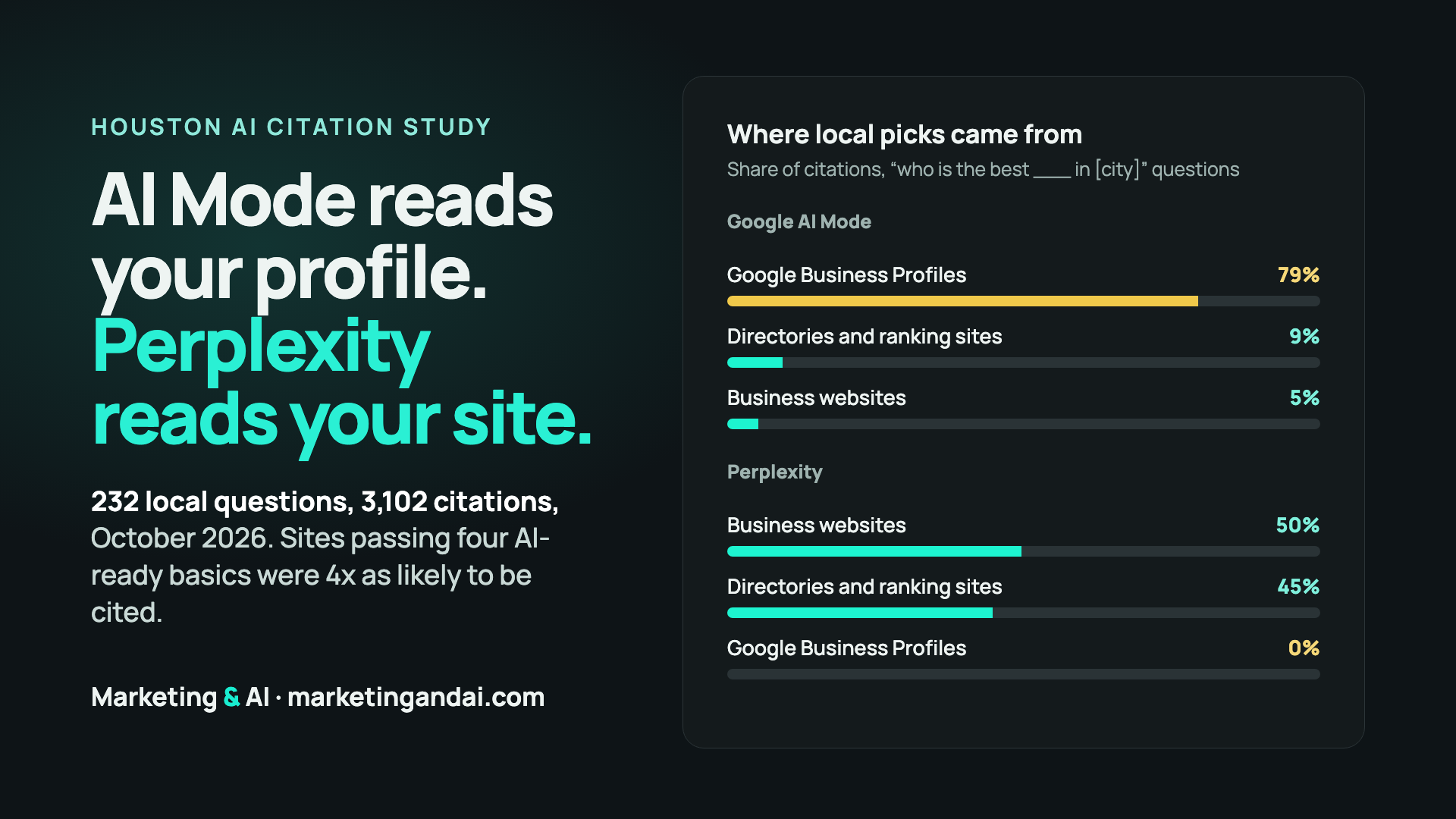
Where local recommendations came from: Google AI Mode cited Google Business Profiles for 79% of citations; Perplexity cited business websites for 50% and directories for 45%
Share of citations on "who is the best ___ in [city]" questions, October 30, 2026. CC BY 4.0.
Share of citations by source type, Google AI Mode and Perplexity
SourceAI Mode, bestAI Mode, pricePerplexity, bestPerplexity, price
Google Business Profiles79%21%0%0%
Local business websites3.5%24%40%39%
Chain and franchise websites1.8%11%7.6%15%
Booking pages (Square and similar)4.2%22%0.1%0.4%
Directories, review and ranking sites9.3%11%45%29%
National how-to and cost guides1.3%7.9%1.4%13%
News and city guides0.2%0%3.1%0.4%
Reddit and social media0.2%0.6%0.8%0.4%
Business sites outside Houston0%2.1%1.4%2.9%
  • AI Mode cites few sources. It averaged 3.4 citations per answer against 10 for Perplexity, and most AI Mode citations on recommendation questions were the Business Profile cards of the businesses it named.
  • Perplexity backs each pick with a source. A business's own website was among the sources for 38% of the businesses Perplexity recommended. The other 60% rested only on third-party pages such as Yelp, Zocdoc, Best Lawyers or HAR.com.
  • Reddit barely appears. It was cited in 9 of 464 answers. For local service questions, both engines went to businesses, directories and Google's own listings instead.
  • City names get confused. 9 of 58 answers about Pasadena, Texas cited businesses in other states, mostly Pasadena, California.

03 / Does an AI-ready website help?

Cited sites pass the basics
twice as often.

We ran every cited local business homepage through the same checks as the Index and compared them with 1,531 Houston business sites in the same industries that were not cited.
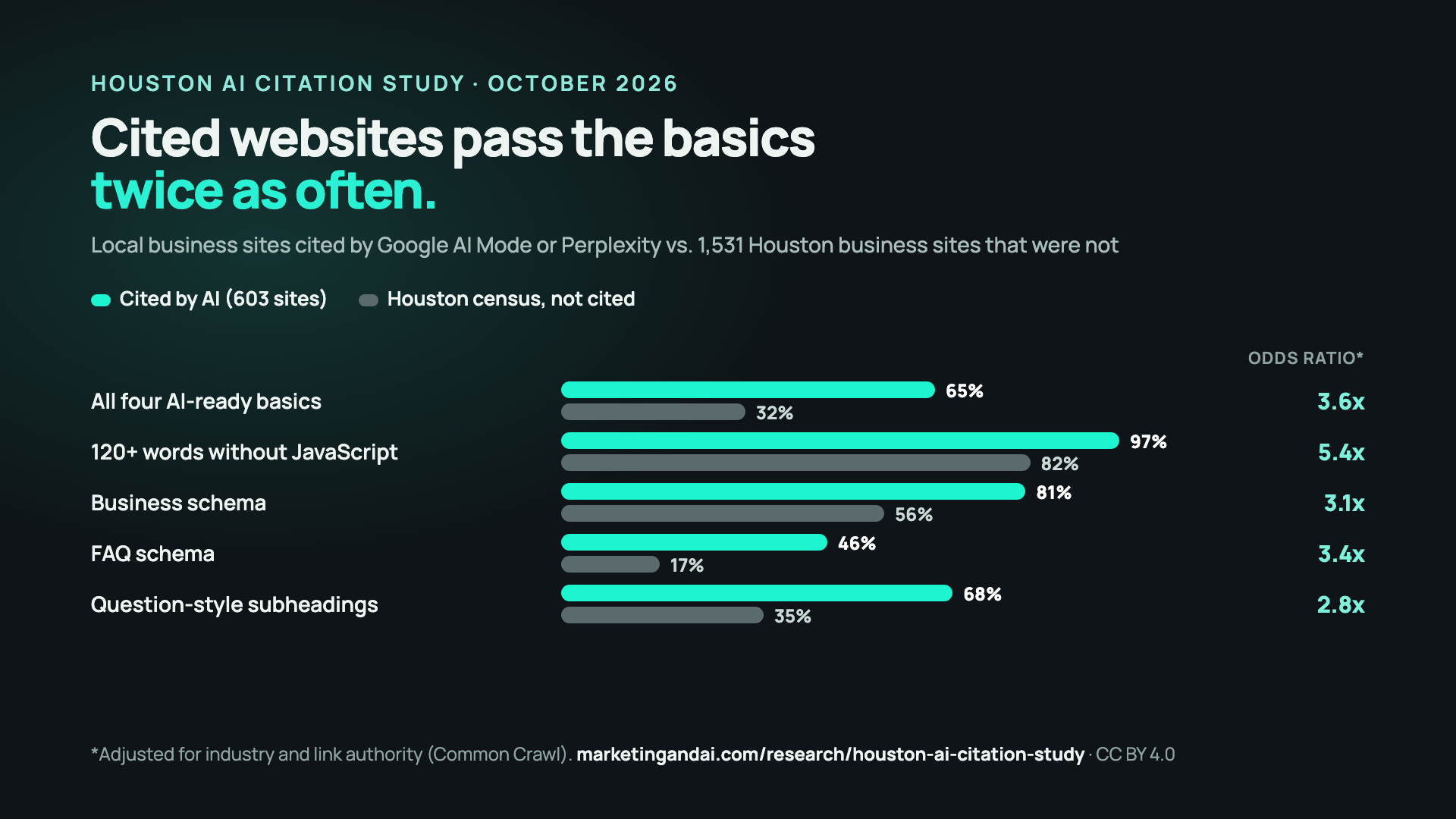
Cited local business websites pass all four AI-ready basics 65% of the time against 32% for Houston business websites that were not cited
Cited local business sites (603) against the Houston census (1,531). Odds ratios adjusted for industry and link authority. CC BY 4.0.
Share of cited and not-cited local business websites passing each check
CheckCited by AINot citedAdjusted odds ratio
All four AI-ready basics65%32%3.6 (2.9 to 4.5)
120+ words readable without JavaScript97%82%5.4 (3.1 to 9.4)
Business schema81%56%3.1 (2.4 to 3.9)
FAQ or Q&A schema46%17%3.4 (2.7 to 4.3)
Question-style subheadings68%35%2.8 (2.2 to 3.5)
Exactly one H176%56%2.6 (2.0 to 3.3)
AI search crawlers allowed in robots.txt98%95%3.4 (1.7 to 6.9)
llms.txt published45%29%2.0 (1.6 to 2.4)
  • The order of events holds. We also looked only at the 1,580 census businesses in these industries, using checks measured on October 2, before any question was asked. 5.9% of sites passing all four basics were cited by October 30, against 1.4% of the rest (adjusted odds ratio 4.6, 95% interval 2.3 to 9.2). FAQ schema (7.4% against 1.9%) and question-style subheadings (5.6% against 1.4%) showed the same pattern.
  • Links do not explain it. Cited sites were not more linked-to than the census: their median Common Crawl rank was 18.2 million, against 14.5 million for the census (a higher number means fewer links). The gap held in every authority quarter, from 81% against 32% among the most-linked sites to 55% against 26% among the least-linked.
  • We then tested 40 factors. Against Houston sites in the same industries, cited sites still passed all four basics more often (68% against 41%, odds ratio 3.0). Of 40 commonly recommended factors, six held up in every test: reviews on the homepage, a specific business type in the schema, prices, years in business, city pages and a meta description. See which AI citation factors matter.
  • This is association, not proof. Businesses that fix the basics often invest in their site and reviews in other ways too. A controlled test by Ahrefs found that adding schema to pages that were already cited did not raise citations; our data covers a different case, local sites that AI had not necessarily seen before.

04 / Google Business Profiles

What AI Mode's picks
have in common.

AI Mode listed 421 businesses in answers to "who is the best" questions. 402 came with a Business Profile card, and 398 of those showed a rating and review count.

4.9

median star rating. 95% had 4.5 stars or more and 81% had 4.8 or more. The lowest rating recommended was 3.9.

398 profiles

323

median review count. 78% had at least 100 reviews and fewer than 1 in 10 had under 50. The first business named had a median of 416.

398 profiles

27

median reviews for SEO agencies. Review counts varied by industry, from 27 for SEO agencies and about 100 for chiropractors to over 700 for dentists and auto repair.

By industry

05 / The pages that get cited

City pages, real prices,
plain answers.

We crawled 1,313 business-website pages that the answers cited. 1,266 were readable.

  • City and location pages were the most-cited business pages (40%), ahead of homepages (21%), service pages (16%) and pricing pages (14%).
  • For "who is the best" questions, 80% of cited business pages named the city in the URL or title, and 61% named it in the H1.
  • For price questions, pricing pages carried the business. 41% of the business pages AI Mode cited on cost questions were pricing or cost pages. Two in three pages cited for price questions had FAQ schema.
  • Cited pages were substantial. The median cited page had 1,235 words readable without JavaScript; 73% had business schema, 57% had FAQ schema and 67% used question-style subheadings.

06 / "Best of" lists

Ranking yourself
did not help.

Some businesses publish "Best plumbers in Katy" posts that list themselves first. We flagged every cited page titled or addressed as a "best" or "top" list.

  • Self-ranking posts were rare: 4.2% of the business pages Perplexity cited and almost none in AI Mode.
  • They gave no measurable edge. When a business's own "best of" post was cited, Perplexity recommended that business 47% of the time, about the same as for businesses whose other pages were cited (45%).
  • Third-party ranking sites matter more. "Best ___ in [city]" lists on directories and ranking sites made up 20% of all Perplexity citations. Being listed on them is a better use of effort than writing your own.

07 / Ask twice

Same sources,
different names.

We asked Perplexity every question again, a median of 10 minutes later.

  • The sources barely moved. The cited domains overlapped 98.5% between the two runs.
  • The top pick usually held: the same business came first in 82% of answers.
  • The full list shifted. Only 69% of the recommended businesses overlapped between runs, so a business on the edge of a list can appear one minute and drop out the next. One check is not a measurement; track a set of questions over time on more than one engine.

08 / ChatGPT and Claude

ChatGPT and Claude
read the directories.

Added October 31, 2026: we sent the same 232 questions, twice each, to ChatGPT search and Claude with web search through their APIs, located in Houston. That is 928 more answers, 1,688 citations and 1,102 recommendations in the main runs.

Four AI engines on Houston "who is the best" questions
"Who is the best" questionsGoogle AI ModePerplexityChatGPTClaude
Citations to Google Business Profiles79%0%0.2%0%
Citations to business websites5.3%49%23%29%
Citations to directories, review and ranking sites9.3%45%68%65%
Businesses named per answer3.94.34.25.0
Picks backed by their own website7.1%38%14%15%
Same top pick when asked againnot tested82%36%56%

ChatGPT and Claude here are their web search APIs on the cheapest models (gpt-5-nano and Claude Haiku 5.5), asked on October 31; AI Mode and Perplexity were asked on October 30. Each engine attaches sources differently: AI Mode through its reference list, Perplexity through numbered citations, ChatGPT and Claude through links inside each list item. "Same top pick when asked again" compares two runs about 6 to 10 minutes apart.

  • Directories carry ChatGPT and Claude. On "who is the best" questions, 68% of ChatGPT's citations and 65% of Claude's went to directories, review and ranking sites. Business websites got 23% and 29%. Only 14 to 15% of the businesses they named had their own website among the sources for that pick, against 38% on Perplexity.
  • Claude reads Yelp; ChatGPT never did. Yelp appeared in 88 of Claude's 120 "best" answers and made up 20% of all its citations. ChatGPT cited Yelp zero times; its most-cited sources were BestProsInTown (69 citations) and Birdeye (48). Which directories matter depends on the engine.
  • Ranking pages feed Claude. 67% of Claude's citations on "best" questions were "best of" or "top 10" pages, against 29% for ChatGPT.
  • Four engines, four different lists. Across the 120 recommendation questions the engines named 1,582 different business and question pairs; 79% were named by only one engine and just 24 by all four. Businesses are matched by name, so one written two different ways can be missed; the true overlap may be a little higher. See what the 24 had in common. ChatGPT's top pick matched AI Mode's 15% of the time and Perplexity's 12%; Claude's matched 7.5% and 9.2%.
  • Consensus picks have big review counts. The businesses that both ChatGPT and AI Mode named had a median of 589 Google reviews, against 323 for all of AI Mode's picks.
  • Price questions still go to business sites. On cost questions, business websites took 66% of ChatGPT's citations and 64% of Claude's, against 57% for Perplexity and 36% for AI Mode (plus 22% to booking pages). Every engine leaned on business sites for prices.
  • ChatGPT is the least consistent. Asked again a few minutes later, ChatGPT kept the same top pick 36% of the time and Claude 56%, against 82% for Perplexity. 17% of ChatGPT's answers had no linked source at all.

09 / By industry

Where each industry
gets its citations.

Both engines, both question types. Business sites include chains; directories include review and ranking sites. The full table is in the data.

Citation sources and AI Mode review counts by industry
IndustryBusiness sitesDirectoriesBusiness ProfilesTop directoryMedian reviews, AI Mode picks
SEO agencies73%19%6.6%Clutch, DesignRush, Semrush27
AC repair62%13%17%HVACService.io462
Personal injury lawyers55%37%4.1%Best Lawyers183
Roofers53%23%12%Woodlands Online211
Dentists52%20%15%Zocdoc718
Car detailing51%20%15%CeramicCoating.com116
Auto repair49%28%9.3%RepairPal743
Veterinarians45%23%16%Pawlicy475
Chiropractors42%32%16%HealthHives, Zocdoc101
Gyms38%25%24%Yelp403
Med spas38%35%18%The Clinic Compass292
Plumbers32%32%8.2%Angi290
Hair salons27%44%18%Fresha203
Mexican restaurants19%44%22%Restaurantji, Tripadvisor1,900
Real estate agents15%72%5.8%HAR.com145

See which SEO agencies the four engines named most: Houston SEO agencies AI recommends.

10 / What to do

Seven moves, from the data.

Ordered by how many answers they touch. Each one maps to a finding above.

  1. Treat your Google Business Profile as your AI Mode landing page. Pick the right primary category, list services and prices, and keep reviews coming. AI Mode's picks had a median of 4.9 stars and 323 reviews.
  2. Pass the four AI-ready basics. Real text without JavaScript, business schema, one clear H1, and no AI search crawlers blocked in robots.txt (check your firewall or CDN bot settings too; they can block a crawler that robots.txt allows). Sites that passed were 4 times as likely to be cited. Our free scanner checks all four.
  3. Publish one page per city you serve, with the city in the title and H1 and details only a local business would know. Four in five cited business pages for "best ___ in [city]" questions named the city.
  4. Put real prices on a page AI can read, and keep the price list on your booking page public. On cost questions, pricing and booking pages carried 63% of AI Mode's business citations and 23% of Perplexity's.
  5. Answer the questions customers ask with question-style subheadings. Cited homepages used them 68% of the time, against 35% of homepages that were not cited. FAQ schema went with citations too (46% against 17%), but in the factor test it added little once other factors were counted. Our answer readiness tool scores a page.
  6. Get listed where AI looks for your industry: HAR.com for agents, Best Lawyers and Justia for attorneys, Zocdoc for dentists and chiropractors, Fresha for salons, RepairPal for auto repair. Directories carried 45% of Perplexity's recommendation citations. For ChatGPT and Claude, see section 08: Claude leaned on Yelp, ChatGPT on BestProsInTown and Birdeye.
  7. Skip self-ranking posts and measure on more than one engine. "Best of" posts about yourself gave no edge, and AI Mode and Perplexity agreed on the top pick only 9% of the time.

11 / Method

How we measured.

Every number on this page is computed by the published scripts from the raw answers.

  • Questions: 15 industries in 8 areas (Houston, Katy, Sugar Land, Spring, The Woodlands, Pasadena, Clear Lake and Humble). Each industry had a "Who is the best ___ in [city], TX?" question and, except restaurants, a price question such as "How much does AC repair cost in Katy, TX?". 232 questions in all.
  • Engines: Google AI Mode, collected through SerpApi with the search located in Houston, and Perplexity Sonar through its public API. Each question was sent alone, with no system prompt and no brand named. All answers were collected on October 30, 2026 between 12:46 and 13:17 UTC; Perplexity's second run followed a median of 10 minutes later. ChatGPT and Claude were added on October 31, 2026 (12:34 to 13:01 UTC): every question twice, through the OpenAI Responses API web search tool (gpt-5-nano) and the Anthropic web search tool (Claude Haiku 5.5), the cheapest models each company offers with web search, located in Houston, with at most two searches per answer and no system prompt. The 928 answers cost about $11 in API fees.
  • Citations: every source URL each answer cited, counted once per answer: 3,102 in the main run (5,422 including Perplexity's second run) from 1,034 domains. Each domain was coded by hand or by rule into a source type; local business sites were confirmed through the Index census, a Texas address or phone in their schema, or a match to a recommended business. Business sites with a non-Texas address were coded as outside Houston.
  • Recommendations: AI Mode's Business Profile cards and named list items, and the bold business names in Perplexity's answers, with the sources each answer attached to that name. A hand check of 55 random Perplexity recommendations found 53 correct names; the two name errors and four website-matching errors it found were fixed before the final analysis. For ChatGPT and Claude, recommendations are the businesses named in list items, with the links inside each item as its sources; hand checks of 50 random recommendations each found 48 correct names for ChatGPT and 48 for Claude (the errors were a firm name split in two and a name cut short). The 396 domains they cited that the first round had not seen were coded by hand the same way.
  • Website checks: cited local business homepages and every cited business page were crawled on October 30, 2026 with the same engine as the Index (October 2, 2026). Link authority is the domain's harmonic-centrality rank in the Common Crawl web graph for August to October 2026. Odds ratios come from logistic regressions with industry fixed effects; percentage intervals use a bootstrap over answers.
  • Limits: one metro, two days (AI Mode and Perplexity on October 30, ChatGPT and Claude on October 31), and API or scraped results rather than a logged-in person's screen. AI Mode's citations come from its reference list, which may not show every source it used. The census covers businesses listed with a website in OpenStreetMap, not every business. Google AI Overviews were not included. ChatGPT and Claude were measured with their cheapest search models through the API, which can answer differently from the default models in the consumer apps, and on the next day.
  • Disclosure: Marketing & AI is a Houston SEO and AEO agency, and SEO agencies were one of the 15 industries. We were not cited or named in any answer.

12 / Data & citation

Use the numbers.

The data is free to reuse with attribution under CC BY 4.0: every question, every citation, every recommended business, and the tables behind this page. Answer text and per-site check results are not published.

Download the summary (CSV)

The full dataset, with the questions and answers tables, a methods note and the analysis scripts, is archived with a permanent DOI on Zenodo, and also published on Hugging Face and Kaggle.

Cite as: Rusic, A. (2026). Houston AI Citation Study, October 2026 [Data set]. Zenodo. https://doi.org/10.5281/zenodo.23837619

13 / Embed

Use the chart
on your site.

Free to republish under CC BY 4.0. Paste the code below into any page or post; it keeps the credit line that the license asks for.

Preview of the embeddable chart: where Google AI Mode and Perplexity get local business recommendations
Embed code (HTML)
<figure style="margin:0"><a href="https://marketingandai.com/research/houston-ai-citation-study/"><img src="https://marketingandai.com/images/houston-ai-citation-study-2026-10.png" alt="Houston AI Citation Study, October 2026: Google AI Mode recommends from Google Business Profiles, Perplexity from business websites and directories" width="1920" height="1080" loading="lazy" style="max-width:100%;height:auto"></a><figcaption>Source: <a href="https://marketingandai.com/research/houston-ai-citation-study/">Houston AI Citation Study, Marketing &amp; AI</a> (CC BY 4.0)</figcaption></figure>

Prefer a plain link? Cite as: Marketing & AI (2026). Houston AI Citation Study, October 2026. doi.org/10.5281/zenodo.23837619

Next / Your business

Find out what AI says about you.

Check your site against the four basics in about ten seconds, free, or book a 30-minute audit and we will show you what Google AI Mode and Perplexity cite for your industry and city.

Check my site free

Questions

About the study.

Where do AI search engines get local business recommendations?

It depends on the engine. In our October 2026 study of 232 Houston questions, 79% of Google AI Mode's citations on "who is the best" questions were Google Business Profiles. Perplexity cited business websites (49%) and directories or ranking sites (45%), and almost never Reddit.

Does Google AI Mode use Google Business Profiles?

Yes. 96% of the businesses AI Mode recommended in our study came from Google Business Profile cards. Those businesses had a median of 4.9 stars and 323 reviews, and 95% had at least 4.5 stars.

Does an AI-ready website help a local business get cited?

In our data, yes, as an association. Houston business sites that passed four AI-ready basics on October 2, 2026 (AI search crawlers allowed in robots.txt, 120+ words without JavaScript, business schema, one H1) were 4 times as likely to be cited by Google AI Mode or Perplexity four weeks later: 5.9% against 1.4%.

Do AI search engines agree on which local business is best?

Rarely. Google AI Mode and Perplexity named the same top business for only 9% of the same questions (10 of 108) and shared any cited source on 25%. Across all four engines, including ChatGPT and Claude, 79% of the businesses named for a question were named by only one engine. Asked again ten minutes later, Perplexity kept its top pick 82% of the time but changed about a third of the businesses it listed.

Do self-promotional "best of" blog posts help?

Not in our data. They made up 4.2% of the business pages Perplexity cited, and the business that wrote one was recommended 47% of the time, about the same as other cited businesses (45%). Third-party ranking sites carried 20% of Perplexity's citations.

Project image

Open original image ↗